The Roots of Removal: The Path to the Japanese American Incarceration

 Written by Jeff Suzuki & Nigel Chandler. Edited by members of the Los Gatos Anti-Racism Coalition.

PUBLISHED NOVEMBER 2, 2025

Pictured: Japanese American women walk to their barracks at Heart Mountain Relocation Center.1 https://centerofthewest.org/2018/12/14/the-war-at-home-women-in-the-workforce-and-world-war-ii-in-wyoming/

This two-part article explores events and policies that paved the way for Japanese American Incarceration, focusing on the genocide of Indigenous people and the racialization of people of Asian descent that began with discrimination against Chinese immigrants.

PART I - The American Indian Connection

Classification No. 123: “Transfer and Removal of Indians”

Hana Chittenden Maruyama is one of many descendants of the Japanese American Incarceration here in California. From 1942 to 1945, her grandmother’s family was imprisoned at the Heart Mountain Concentration Camp in Wyoming–the same camp as the Inouye family of Los Gatos–and her grandfather’s family at the Gila River War Relocation Center in Arizona. At the time of the Japanese American Incarceration, it had been nearly 60 years since the Office of Indian2 Various terms are used to refer to the Indigenous peoples of the United States, including “American Indian,” “Indian,” “Native American,” “Native,” and “Indigenous.” All of these terms have varying degrees of acceptability depending on the preferences of the tribes, nations, and peoples that are referred to by these terms. Legal institutions in the United States typically use the term “American Indian” or “Indian.” When possible, LGARC uses the specific names of the tribes, nations, and peoples in question. Many of LGARC’s sources for this article, some of which are written by California Indian people, use the term “California Indian” when referring to this particular state’s Indigenous population. When making generalizations across groups of Native peoples, LGARC uses each term mentioned above interchangeably and without preference. See the following “National Museum of the American Indian” explainer and FAQ for more information on acceptable terminology. Affairs forced the Apsáalooke (Crow) to leave Heart Mountain, a sacred landmark of their people.3 https://wyoarchaeo.wyo.gov/index.php/learn/wyoming-archaeology-awareness-month/project-a-day/82-september-25-heart-mountain-archaeology-3,4 https://conservancy.umn.edu/server/api/core/bitstreams/1d37d335-f5c2-41ec-9cd6-3f3c0e1bcf7a/content Page 1, footnote 1 details the timeline of the relocation of the Crow people from Heart Mountain. The Gila River War Relocation Center was placed on the Gila River Indian Reservation, against the will of the local Akimel O’odham (Pima) and Piipaash (Maricopa) people. For years, Maruyama had wondered why the American government would choose, out of all the places in the country, actual Native reservations and sacred sites to place their concentration camps. She decided to investigate.
As part of her research efforts, she examined documents belonging to agencies directly involved in planning and executing the Incarceration. In her research, she discovered that files detailing the incarceration of Japanese Americans on native lands were labeled with the classification “Transfer and Removal of Indians.”5 https://conservancy.umn.edu/server/api/core/bitstreams/1d37d335-f5c2-41ec-9cd6-3f3c0e1bcf7a/ Page 27 details the discovery of the BIA documents handling Japanese Internment. This is not a coincidence, as many of the bureaucratic mechanisms used by the Bureau of Indian Affairs (BIA) to manage the Indian Reservation system were inherited by the War Relocation Authority (WRA), which facilitated the Japanese American Incarceration. In fact, much of the leadership and staff of the WRA came directly from the BIA when it was established.6https://www.pbssocal.org/news-community/how-japanese-american-incarceration-was-entangled-with-indigenous-dispossession Note: Two of the ten internment camps used during the war were placed directly on Native reservations, on the Gila River and Colorado River Indian Reservations in Arizona.
Pictured: E.R. Fryer, San Francisco Regional Director of the War Relocation Authority, in his office on May 12th, 1942.7 https://oac4.cdlib.org/ark:/13030/ft2v19n7kf/?order=2&brand=oac4. Prior to the war, Fryer had a career with the Bureau of Indian Affairs.8 https://www.pbssocal.org/news-community/how-japanese-american-incarceration-was-entangled-with-indigenous-dispossession.
Agnes Savilla, a Mohave woman who worked for the Colorado River Indian Community Council in the spring of 1942, observed that the Council had two reactions when pressured to accept a concentration camp on their lands: first, that their land was being taken again and, second, that the government was treating Japanese Americans “just like us.”9https://conservancy.umn.edu/server/api/core/bitstreams/1d37d335-f5c2-41ec-9cd6-3f3c0e1bcf7a/content Page 14.

The "War of Extermination" in California

In 1848, after Mexico’s defeat in the Mexican-American War, the United States forcibly annexed over half of Mexico’s territory. California, the most valuable of these territories, would soon become the focal point of the American drive West to fulfill the country’s so-called “Manifest Destiny.” This westward expansion is often romanticized in popular culture, accompanied by the enduring image of the hardscrabble frontiersman risking it all to seek a new life and, in doing so, spreading democracy and civilization from sea to sea. What is not so often mentioned is that an explicit, state-sponsored campaign of extermination against the California Indians began virtually as soon as the American settlers arrived. In the words of California’s first governor, Peter Burnett, in 1851: “That a war of extermination will continue to be waged between the races until the Indian race becomes extinct must be expected. While we cannot anticipate this result but with painful regret, the inevitable destiny of the race is beyond the power or wisdom of man to avert.”10 https://governors.library.ca.gov/addresses/s_01-Burnett2.html As Governor Burnett anguished over the “inevitable destiny” of this “war of extermination,” his government actively rewarded those settlers who dealt violently with the “Indian Problem.” The state and federal government spent over $1,700,000, a massive sum for the day,11 There is no reliable way to account for inflation going back this far into the past, as the Consumer Price Index had not yet been invented and the necessary data was not actively recorded by the government.on campaigns of military and vigilante violence against California Indians.12 https://newsroom.ucla.edu/stories/revealing-the-history-of-genocide-against-californias-native-americans State legislators raised money for state militias, and money from state coffers was used to reward the settlers and organized local militias who participated in the killing.13 https://www.pbssocal.org/shows/tending-the-wild/untold-history-the-survival-of-californias-indians In the first two years of the Gold Rush, settler violence killed over 100,000 people out of an estimated population of 150,000 California Indians, according to California’s own Native American Heritage Commission.14https://nahc.ca.gov/native-americans/california-indian-history/

 In a stunning wave of violence, from an estimated population of 150,000 in 1848, the Native Californian population was reduced by as much as 100,000 within the first two years of the Gold Rush.

Adding to the campaigns of murder and frontier violence, the California Indian population faced the iron fist of the law of this new settler state. In 1850, the California Legislature passed a series of laws that effectively legalized the violent enslavement of California Indians.16 https://nahc.ca.gov/native-americans/california-indian-history/ These laws had seemingly humanitarian titles like the “Act for the Government and Protection of Indians.”17 https://www.aclunc.org/docs/FINAL_Act_for_Government_and_Protection_of_Indians.pdf Empowered by state, county, and local laws, settlers engaged in the gruesome practice of killing Indian parents before kidnapping and indenturing their young children, who could be kept as slaves until the age of 30 for men and 25 for women.18 https://nahc.ca.gov/native-americans/california-indian-history/ Meanwhile, adult Indians found guilty of any crime, including “vagrancy,” would be auctioned off by the state to the highest bidder.19 https://www.aclunc.org/docs/FINAL_Act_for_Government_and_Protection_of_Indians.pdf Other survivors were herded together, without regard for tribal affinity, and placed into newly-established “reservations” located in far-flung and resource-poor areas of California with little to no government assistance. The remaining majority of California Indians found themselves on the brink of starvation, forced to find work as landless laborers on the new settlers’ farms and ranches.20 https://nahc.ca.gov/native-americans/california-indian-history/
Abject living conditions and disease led to further deaths. By 1870, The California Indian population numbered only 30,000; by 1880, less than 16,000 remained. In other words, after only 32 years under U.S. “government and protection,” just 10% of the California Indian population managed to survive.21Madley, Benjamin. 2016. An American Genocide : The United States and the California Indian Catastrophe, 1846-1873. New Haven: Yale University Press. Table C-1 containing demographic data is located on page 347. With the government’s unambiguous targeting of an ethnic group with the aim of its destruction, many historians now recognize that this event constitutes a genocide. After many decades of persistent and vocal advocacy from California Indians, the State of California acknowledged the event as the California Genocide in 2019, finally making an official apology for it for the first time in California’s history.22 https://www.nytimes.com/2019/06/19/us/newsom-native-american-apology.html Five years later, in September 2024, a bill was signed into law requiring California schools to teach about this genocide.23 https://calmatters.org/education/k-12-education/2024/10/native-american-history/
Pictured: Three California Indian girls, circa 1866.24 https://calisphere.org/item/ark:/13030/kt4h4nc3xh/ . Tribal affiliation unknown.
The territory that our Town, Los Gatos, sits on is land that is claimed by the Muwekma Ohlone Tribe and the Tamien Nation. No land or reservation has been provided to either tribe by the government, as the tribes remain federally unrecognized, depriving them of rights and privileges granted by federal recognition, including certain rights to self-government (i.e., tribal sovereignty) and federal benefits and services.25https://www.bia.gov/faqs/what-federally-recognized-tribe In the County of Santa Clara, displacement remains a major problem for our indigenous population. In a Muwekma Ohlone Panel Discussion hosted by The Harker School, Stanford professor Dr. Laura Jones describes the “modern displacement” of Bay Area Indians, considering gentrification to be another phase in the displacement of the California Indian population that has persisted since Spanish colonization, a view endorsed by the Muwekma Ohlone Tribe. In other words, displacement continues to be a major problem for our Native population, who must now pay the high rents and property prices demanded by Bay Area landowners to remain on a land that they have historically been denied ownership over.26https://youtu.be/j6wB78aRYpM?si=ocLA3QvdymCSawKb&t=2651


The territory that our Town, Los Gatos, sits on land that is claimed by the Muwekma Ohlone Tribe and the Tamien Nation. No land or reservation has been provided to either tribe by the government.

Of particular relevance to the Japanese American Incarceration was the Indian reservation system implemented across the United States. By the time American settlers expanded into California in 1849, settlers had nearly a century of institutional experience in relocating indigenous populations.27https://web.archive.org/web/20180712222115/https://www.nationalgeographic.org/thisday/aug29/first-indian-reservation/ . The First Indian Reservation was established in 1758 in Shamong Township, New Jersey. There was a blueprint to this process, which is reflected in the fact that there are currently nearly one hundred distinct reservations in California alone.28https://courts.ca.gov/programs-initiatives/tribalstate-programs/california-tribal-communities In many reservations across the United States, especially through the 19th century, Native Americans were considered non-citizen “wards of the state” who needed permission from a federal Indian Agent to leave the confines of the reservation.29https://files.cfc.umt.edu/cesu/NPS/UMT/2004/Campbell_Etnobotony%20Report/Chapterthirteen.pdf The following is an example from Colorado, which applied to the Ute Indians. See pg. 992. Laws were passed to finance the “removal” of Indians who refused to stay inside their allotted reservation land,30https://lib.guides.umd.edu/c.php?g=1261350&p=9246797 See the Indian Appropriation Acts of 1851, 1871, and 1885. with massacres perpetrated against those who chose to leave.31https://www.britannica.com/event/Wounded-Knee-Massacre The Wounded Knee Massacre of 1890 is one prominent example; a group of Lakota Indians attempted to trek from their homes in the Cheyenne River Reservation to the Pine Ridge Reservation, a separate Lakota reservation. The U.S. Cavalry, suspicious of their intentions, massacred the group at their camp at Wounded Knee. Minus the massacres, we would see an eerily similar system, the so-called “Japanese Internment,” used to manage the displaced Japanese-American population decades later.
In this way, the Indian reservation system established the bureaucratic mechanisms that would later be borrowed by the War Relocation Authority in the 1940s. As the Native Americans of our country were purposely shunted off into the most desolate and ‘worthless’ lands to be found in the 19th century, the Japanese Americans would find themselves similarly shunted off to the most desolate and ‘worthless’ lands to be found in the 20th century, some of which directly overlapped, as they did at the Gila River and Colorado River Reservations in Arizona. Ultimately, the Indian reservation system would set a disturbing precedent for how the government handles the survivors of a “war between races.”

When the United States entered the Second World War, the United States had three sizable populations who had direct or ancestral ties to the Axis Powers: Germany, Italy, and Japan. There was a stark difference in the treatment of these “White”32“White” in this article is capitalized when referring to groups racialized as “White” in the United States in most cases, in accordance with the Center for the Study of Social Policy’s statement on the practice and in accordance with the Chicago Manual of Style, the writing style most often favored by historians.
https://cssp.org/recognizing-race-in-language-why-we-capitalize-black-and-white/ and https://cmosshoptalk.com/2020/06/22/black-and-white-a-matter-of-capitalization/.
Americans with their Japanese counterparts. For these “White” Americans, the federal government deemed some immigrants born in Germany and Italy as potential threats. In other words, the federal government used national identity and suspected ties to these nations, as opposed to racial identity, as the standard to assess threats to the war effort. Indeed, the United States deported over 4,000 ethnic Germans and Italians, including large numbers of Jewish refugees who fled from Nazi-controlled Europe.33https://encyclopedia.densho.org/German_and_Italian_detainees/#Comparison_to_the_Japanese_American_Experience However, the federal government soundly rejected proposals to detain the entirety of the German-born and Italian-born population with U.S. citizenship. Meanwhile, the government incarcerated the entire Japanese American population along the West Coast. Whether or not the Japanese American was a native-born U.S. citizen or foreign-born, young or old, rich or poor, the Japanese American was an Asian. And by the time the Japanese Empire bombed Pearl Harbor, the United States had spent almost a century developing attitudes and laws in dealing with the Asian.


In this way, the Indian reservation system established the bureaucratic mechanisms that would later be borrowed by the War Relocation Authority in the 1940s….


Ultimately, the Indian reservation system would set a disturbing precedent for how the government handles the survivors of a “war between races.”

PART II - "The Yellow Peril"

Racialization: “The extension of racial meaning to a previously racially unclassified relationship, social practice, or group.”34https://www.aiany.org/wp-content/uploads/2021/03/Omi_and_Winant_Preface_and_Ch.4.Racial_Formation_2015.pdf pg 111.
Prior to their expulsion to the concentration camps in 1942, Japanese Americans like the Inouye family were subject to levels of discrimination considered nearly unthinkable today. The parents of the family, Hirokichi and Asa, were considered “aliens ineligible for citizenship.” No matter how long they stayed in the country, whether or not they learned English or assimilated into their community, their place of birth would bar them from any possibility of becoming U.S. citizens under federal law.35Naturalization was impossible for any Asian born outside the United States. The flow of Asian immigrants was halted by an immigration reform law passed in 1924. Until 1952, Japanese immigrants had no legal path to citizenship whatsoever, a period of nearly 30 years (and more, for the vast majority of Japanese who came before the 1920s). In 1942, no one had any way of knowing when, or even if, the naturalization laws would be reformed, and as such had no hope for citizenship. Many Japanese immigrants who had lived in the U.S. for decades, like Hirokichi (who passed away during the Incarceration), would not ever live to see the day where they could legally qualify for citizenship. Only their children born in the United States could gain citizenship, by birthright. https://www.migrationpolicy.org/article/1924-us-immigration-act-history, https://history.state.gov/milestones/1945-1952/immigration-act, https://lgarc.org/a-story-of-resilience/. Under the same law, distant family members from Japan were barred from being able to visit their relatives in the U.S., as by this time, the United States had for nearly two decades barred any person from Asia from entering the country for nearly any purpose.36 Under the same 1924 law, the United States Border Patrol was established to enforce these harsh restrictions.
Pictured: The Inouye family home in Los Gatos, from which the Inouye family was removed to Heart Mountain Relocation Center in Wyoming. Photo courtesy of Gordon Yamate, chair of the Los Gatos Diversity, Equity, and Inclusion Commission.
Neither Hirokichi nor Asa were able to purchase or own land in their name, by the letter of the law–in order to acquire their home in Los Gatos, they would have needed to put their land in the name of one of their children with U.S. citizenship, a loophole that would be closed within a year after the Inouyes managed to purchase their home on Canon Drive.38https://immigrationhistory.org/item/alien-land-laws-in-california-1913-1920/ Asian non-citizens were barred from land ownership in California in 1913, while the citizen child loophole was closed in 1920. In the case of the Inouye family, Gordon Yamate has stated that the property may have belonged to a corporation controlled by the minor children as shareholders, another common loophole that was also outlawed in the same 1920 law. Had any of Hirokichi and Asa’s children wished to rent or purchase their family home, or if the family considered moving, they would have needed to navigate racially restrictive covenants that banned the so-called “Mongolian race” from living in White neighborhoods, which covered wide swathes of land in Los Gatos and the rest of the Bay Area.39 In the case of the Inouye family, Hirokichi was the foreman of the Hume Ranch. When the Ranch closed, as a token of gratitude, Hirokichi was given his choice of land to purchase from the owner after he subdivided the property. This is an atypical arrangement, where restrictive covenants would not have been drawn up by the owners. In other areas of Los Gatos and the Bay, homeowners’ associations and developers of new housing used restrictive covenants to market whole tracts of housing to White people as White-only neighborhoods. See the following sources for more information regarding racially restrictive covenants: https://depts.washington.edu/civilr/covenants_report.htm, https://www.kron4.com/news/bay-area/stanford-researchers-map-white-only-properties-in-santa-clara-co-using-ai/, and https://encyclopedia.densho.org/Restrictive_covenants/ m Had any Japanese Americans in Los Gatos wished to marry a White person, they would have been barred from doing so by law.40https://escholarship.org/uc/item/6v96n5xf See pg. 22. Interracial marriage between Asians and Whites was made illegal in 1905. The Inouye children grew up at a time when millions of White Americans had joined the newly reformed Ku Klux Klan,41https://www.fbi.gov/history/famous-cases/kkk-series Membership in the KKK peaked in the mid-1920s before falling due to internal scandals and the jailing of prominent members. Despite this, racial enmity remained high throughout the 1930s and 1940s. and where prominent Harvard anthropologists could win themselves headlines like “Sterilization Urged to Purify Racial Strains” in mainstream newspapers like the San Jose Mercury Herald.42https://drive.google.com/file/d/1d45o1ZvcLRDqsNvsTuAEzbhHbFTxihJS/view?usp=sharing In other words, the Inouye family experienced one of the most intense periods of normalized racial hatred in our nation’s history. 

“No person of African, Japanese, Chinese or of any Mongolian descent shall be allowed to purchase, own, lease, or occupy any residence lot, except in the capacity of domestic servants.”

Pictured: A White woman points to an anti-Japanese sign above her house, circa 1920.43 https://eji.org/news/californias-alien-land-laws/

The Modern Roots of Anti-Asian Racism

It is important to note that this environment of “normalized racial hatred” with its legal discrimination against Asian people had only emerged in the span of a few decades. A common belief is that humans have always been racist toward each other, and that, perhaps tragically, to be racist is an intractable part of human nature.44 Adding to the confusion is the fact that the adjective “racist” is often used synonymously with words like “xenophobic” (a hatred or fear of people from other countries) or, most broadly, “prejudiced.” Underpinning this belief is the assumption that humans have always belonged to social and/or genetic categories called “races.” This view is called “race essentialism,”45https://archive.org/details/sim_historian_summer-2010_72_2/page/298/mode/2up a view that has been rejected by modern anthropologists and scientists.46https://archive.nytimes.com/www.nytimes.com/library/national/science/082200sci-genetics-race.html Rather, it is more instructive to understand race not as something inherent to humans, but as a modern ideology that is less than 350 years old.47https://www.scienceopen.com/hosted-document?doi=10.13169/intecritdivestud.7.1.0086#:~:text=Granted%20that%20it%20(%20The%20Bell%20Curve,considered%20synonymous%20with%20%E2%80%9Cobjective%E2%80%9D%20(%20Fraser%2C%201999)

And like all ideologies, the definitions of “race” and the legal and cultural significance of those definitions have changed over time. One such example of how these definitions change over time is the White racial identity. Famously, depending on their time and location in the United States, Irish and Italian immigrants were not recognized as fully “White” in the United States.48https://www.research.unipd.it/bitstream/11577/3396871/1/IAR%2011.1_Luconi.pdf Pg. 19. These immigrants often experienced cultural, economic, and legal discrimination until they were steadily melted into the “White” categorization. Meanwhile, Chinese, Japanese, and a litany of other peoples diverse in their cultures and languages were reduced to a single racial category: “Asian.” Even though Japanese Americans were not the first victims of racial discrimination against Asians, the fact that they were categorized as such had dire consequences, regardless of whether they were born and recognized as citizens.

In California, discrimination against Asians began at the same time as the California Genocide: during the California Gold Rush. After 1848, tens of thousands of Chinese quickly picked up on the legends of gold and opportunity far away from their own homelands, which had been both destabilized by European colonialism and devastated by the single bloodiest civil war in human history.49https://www.thecollector.com/the-taiping-rebellion-the-bloodiest-civil-war-youve-never-heard-of/ China would be ravaged by a series of crises from 1839 to 1864, beginning with the Opium Wars and ending with the Qing Empire’s eventual victory against the forces of the Taiping Rebellion. The Rebellion was led by Hong Xiuquan, a particularly interesting figure in Chinese history who proclaimed himself to be a son of God and the younger brother of Jesus Christ. The Rebellion killed at least 20 million people. That same year, economic catastrophes and failed revolutions ravaged much of Europe, which spurred millions of people to seek a new life in the United States over the following decade,50https://web.archive.org/web/20190310030352/https://www.dhs.gov/sites/default/files/publications/Yearbook_Immigration_Statistics_2008.pdf a portion of whom migrated to California. While the California Indian population experienced a “war of extermination” shortly after the US annexed California, relations between European immigrants and descendants and Chinese immigrants started as remarkably tolerant; white miners initially encountered Chinese immigrants with curiosity and cordiality as opposed to hostility.51https://www.ilhssf.org/wp-content/uploads/2015/09/Irish-and-Chinese-Labor-.pdf , pg. 59. In fact, the first mayor of San Francisco formally included Chinese community leaders in the city’s civic affairs.52 Ibid, pg. 59. In 1852, The Daily Alta, a San Francisco newspaper, even predicted long-term racial integration: “The China boys will yet vote at the same polls, study at the same schools and bow at the same altar as our own countrymen.”53 Ibid, pg. 58. 

As miners exhausted the most accessible gold deposits in the first few years of the Gold Rush, the state’s large and growing population of Chinese immigrants sought work in agriculture, fishing, and most famously in building up the West’s railroad network. This network included the Transcontinental Railroad in the 1860s and Los Gatos’s very own South Pacific Coast Railroad through the Santa Cruz mountains in the 1870s.54https://www.kqed.org/news/11869346/the-story-behind-those-old-train-tunnels-in-the-santa-cruz-mountains As the flow of gold dried up, the competition for these jobs grew bitter, quickly dividing the new California settlers along racial lines. Tensions rose between people of European descent and their perceived adversary: cheap Chinese labor. As tensions festered and escalated in the ensuing decades, White workers sought to protect their economic interests from competition. Their efforts culminated in a series of laws that formally established white supremacy over the Chinese and, after a few decades, the Japanese at both the state and national level.

Pictured: A Chinese railroad worker stands outside a worker’s barracks at the Summit Tunnel’s northern portal, on the Santa Cruz Railroad running through Los Gatos (1870s).55 https://www.santacruztrains.com/2017/12/tunnels-summit-tunnel-2.html .
  The crucial legal case that decided the racial status of the Chinese immigrant population in California was the California Supreme Court case People v. Hall (1854).56https://immigrationhistory.org/item/people-v-hall/ The subject of the case was a Chinese man was murdered by a White man in the presence of Chinese witnesses. These Chinese witnesses sought justice by pressing charges against the murderer. Existing laws forbade Black people and Indians Americans in California from testifying in court based on their race. From this emerged a legal question: could the Chinese be subjected to the same laws? While a lower court upheld the rights of the Chinese and convicted the murderer,57https://stephenchahnlee.medium.com/the-opinion-that-silenced-non-white-people-f0db146fe56c In fact, the lower court judge in this case, Judge William Barbour, made the following poignant statement upon sentencing Hall to death for the murder. “You most unfortunately have participated in a delusion which has prevailed to an alarming extent in California. Many persons here have supposed that it is less heinous to kill a Negro, an Indian, or a Chinaman than a white person. This is a gross error. The law of our country throws the aegis of its protection upon all within its jurisdiction; it knows no race, color or distinction.” This is a remarkable anti-racist judicial statement to be made in America in 1854, made even before the Civil War broke out in 1861. See Stephen Lee’s analysis of this case for more information regarding this point. the California Supreme Court instead decided to formally extend the racially discriminatory laws, ruling that the Chinese are likewise considered an “inferior” race that cannot testify in court against White people. The Chinese witness testimony was thrown out, and the White man who murdered the Chinese man was set free, which served to encourage White settlers to act with impunity against people of color—a category that now explicitly and legally included the Chinese. 
Pictured: An 1879 Harper’s Weekly political cartoon, depicting a Black man and a Chinese man with the dual captions “The N***er Must Go” and “The Chinese Must Go.” Another subtitle reads: “The poor barbarians can’t understand our civilized republican form of government.”58 https://immigrationhistory.org/item/people-v-hall/


Despite their second-class racial status in California and the decline of the Gold Rush, Chinese immigrants continued migrating into the state in larger numbers. In the 1860s, over 54,000 Chinese immigrants arrived in the United States. Ten years later in the 1870s, the number of Chinese immigrants received by the United States almost tripled to over 130,000.59https://web.archive.org/web/20190310030352/https://www.dhs.gov/sites/default/files/publications/Yearbook_Immigration_Statistics_2008.pdf Even though the United States had received over 4 million European immigrants in the same two decades,60 Ibid. White Americans viewed Chinese immigrants as a threat, mainly because they were seen as competition for the White working class. Take, for example, these excerpts from an article in the Los Gatos News, published in November 1885, which commemorated the first meeting of the Anti-Chinese League of Los Gatos:61https://drive.google.com/file/d/1FEa2isl19oXZqZCQP-aX_Lv_K8CSL9nW/view?usp=sharing

  “Persuant to [the] call in the News of last week, a mass-meeting was held at Lyndon Hall on Monday evening. The hall was well filled, showing that the anti-Chinese feeling is strong. It is clear to all thinking people that the presence of the Chinese is not calculated to elevate the morals of any community. It tends to form classes in society and thus drive the most desirable laboring classes to other places where their services are better appreciated. It makes the rich richer, but does not develop a good healthy laboring element which is the basis of our American government. Our political and moral institutions demand a healthy middle class of citizens, who have and feel an interest in the affairs of the State or Government. […] We, the undersigned citizens of Los Gatos and vicinity, do agree to form ourselves into a league to be known as the Anti-Chinese League of Los Gatos; and do hereby agree to conform to the following resolutions:

1st. We will not employ Chinese labor in any form.

2d. We will as far as possible avoid dealing with those who employ such labor.

3d. We will as far as possible avoid buying goods manufactured by Chinese labor.

4th. That we demand of our merchants that they buy goods manufactured by white labor.

5th. We will use our influence as far as possible, politically, to elect such men to office as are known to be anti Chinese advocates.”

Pictured: Article from the first meeting of the Anti-Chinese League of Los Gatos (1885).61 https://drive.google.com/file/d/1FEa2isl19oXZqZCQP-aX_Lv_K8CSL9nW/view?usp=sharing

A few years prior, in 1882, the United States had passed the Chinese Exclusion Act, the first law in our country’s history to explicitly62https://immigrationhistory.org/item/page-act/ In 1875, seven years before the Chinese Exclusion Act, the Page Act effectively banned the immigration of Chinese women into the United States. However, the language of the law was not explicit towards the Chinese, instead targeting immigrants who were allegedly under contract to perform services for “lewd and immoral purposes.” halt the immigration and naturalization of a group of people on the basis of race and national origin. The Act completely stopped legal Chinese immigration into the United States, and barred those already in the country from a path to citizenship, turning them into permanent aliens with no right to vote or hold political office. Perhaps, if the United States had not uniquely barred the Chinese from citizenship, they would not need to be so concerned about their supposed lack of “interest in the affairs of the government.” The fourth resolution of the meeting makes it clear that the “most desirable laboring classes” who have a supposed “tendency” to be driven out by the Chinese are, specifically, “white labor.”


The Chinese would not remain the sole targets of anti-Asian racial hatred for long. With Japanese migration to the United States through the 1880s and 1890s, followed closely by the ascendance of the Japanese Empire on the international stage, Japan would begin to acquire a special place in the American consciousness. Japanese farmers in particular became highly successful agriculturists,64https://www.nber.org/system/files/working_papers/w33971/w33971.pdf , pg. 2. and were viewed as direct competitors with their White counterparts, same as the Chinese were to the White working class in the decades prior. The Japanese Americans’ success in the industry caused many White people, especially White farmers, to believe that the Japanese were a threat to the (White) “American way of life,”65https://cdnc.ucr.edu/?a=d&d=LGT19420821&e=——-en–20–1–txt-txIN——–&__cf_chl_tk=hwX_Ib7gYjZdi78enKBOO2373.mHFAq2RF9EBIJNC98-1762134962-1.0.1.1-JVESj4rZATjsutGe0fJsh6aCSHMDQiwZAbfiBVpFOrM See, for example, the Los Gatos Times article published in 1942, referenced in this article series’ introduction. Pg. 2, left-most column. and to believe that legal restrictions on land ownership among Japanese immigrants would safeguard the economic and political sovereignty of the nation. The Chinese, Japanese, and other Asian races began to be lumped together into a single “Asian,” “Mongolian,” or “Oriental” race, and the laws that were created to address the “Japanese problem” were applied universally to all Asians–as in, to all “Orientals who cannot become American citizens.”66https://repository.uclawsf.edu/cgi/viewcontent.cgi?article=1129&context=ca_ballot_props In the original ballot materials of the 1920 proposition to close the legal loopholes that existed for restricting Japanese land ownership, the supporting argument contains sections that get to the heart of the matter: “Through the measure California seeks, as is her inherent right, to preserve her lands, precisely as Japan preserves her lands for the Japanese. Its primary purpose is to prohibit Orientals who cannot become American citizens from controlling our rich agricultural lands. … In defiance of [the 1913 Alien Land Law], through various subterfuges including dummy corporations and minor native born children, Orientals, largely Japanese, are fast controlling the richest irrigated lands in the state, through lease or ownership, the proportion already controlled in some counties being from 50 to 75 percent. … Control of these rich lands means in time control of the products, and control of the markets. Control of the products of the soil by a unified interest such as the Japanese will lead to economic control of the country. That will be followed in time by political control through force of numbers induced by the heavy birth rate. That condition is now at hand in Hawaii. Rather than invite such disaster, better to let some land lie idle, and a few large landholders make less profit, and even see production decrease somewhat, as opponents claim will result if this measure passes.”


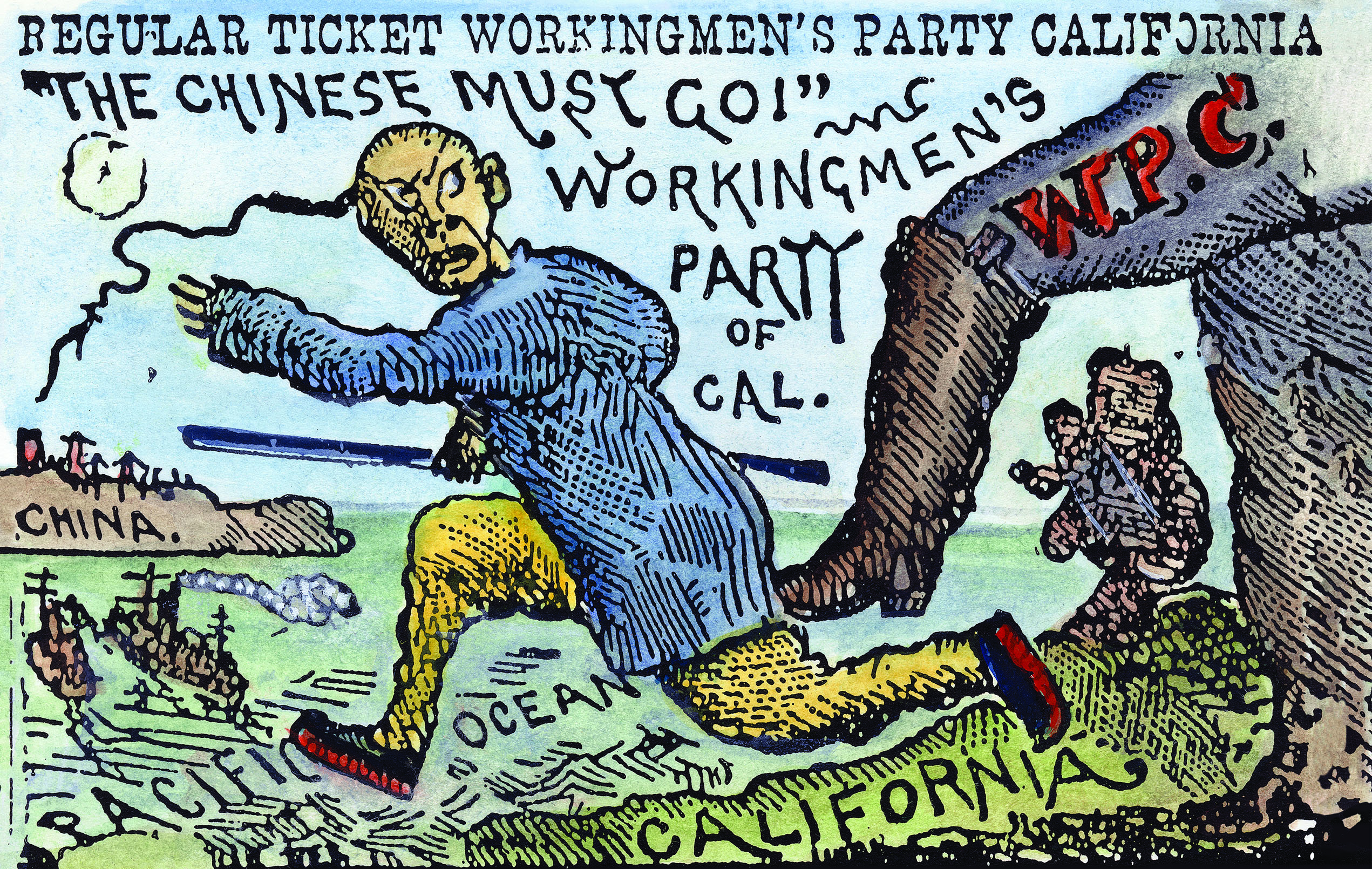
In California and other Western states, opportunistic politicians, journalists, and labor unions warned that hordes of Japanese would overrun the United States, take control, and corrupt and contaminate the White race. These same slurs had earlier been directed at Chinese laborers. In stereotypical images, Asians were depicted as menacing, clawed creatures regardless of nationality. They were declared inferior to Whites, but at the same time attributed mysterious “Oriental” powers and devious plans. Newspapers claimed that Japanese workers could survive worse living conditions than Whites, and greatly exaggerated the birth rate among Japanese women. Japan’s military expansion in the early part of the century accelerated “Yellow Peril” warnings that an invasion of the continent was imminent. For the longtime foes of the Japanese in America, the surprise attack on Pearl Harbor pitted the United States not just against an enemy nation but against an enemy race.68https://nikkeijin.densho.org/JA20/reference_ch1_03_yellow_peril_en.html Description of the Yellow Peril taken from Densho educational materials. It is in this context that the War Relocation Authority that organized the Japanese American Incarceration was conceptualized, steeped in the same racial logic as the “war of extermination between the two races” that California’s first governor, Peter Burnett, had proclaimed against the California Indians nearly one hundred years before.

Pictured: A Workingmen’s Party of California graphic featuring anti-Chinese propaganda.63 https://www.historynet.com/wp-content/uploads/2021/11/Chinese-Immigration-Act.jpg
Pictured: An 1895 Harper’s Weekly lithograph, portraying an angel urging the countries of Europe to prepare themselves against the “Yellow Peril” to the East. 67 https://upload.wikimedia.org​/wikipedia/commons/f/fa/Voelker_Europas.jpg The lithograph was made in response to Japan's victory in their war against the Qing Empire in 1895.
Pictured: An influential white supremacist book, published in 1920, commented on by such famous public figures as W.E.B. DuBois, President William Harding, and Franz Boas. The author pointed to the Russo-Japanese War of 1905 as a direct example of the threat Asians pose to “White World Supremacy.” 69 https://en.wikipedia.org/wiki/The_Rising_Tide_of_Color_Against_White_World-Supremacy The Japanese “red sun,” or Hinomaru, is featured prominently on the book’s cover.
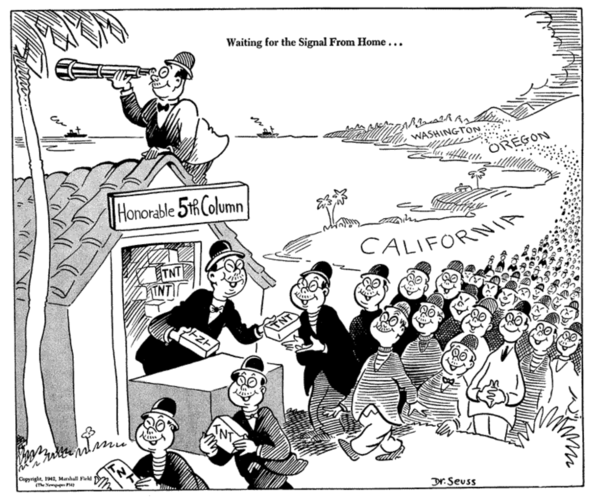
Pictured: Political propaganda illustrated by the cartoonist popularly known as Dr. Seuss in 1942, portraying Japanese Americans as a “fifth column” (traitorous class) working against the United States on the West Coast.70https://upload.wikimedia.org/wikipedia/commons/b/b0/Seuss_cartoon.png


 Lessons for Today

If a single lesson is to be taken from the histories we have detailed above, it is that what we now consider to be social progress in our country should never be taken for granted. People do not necessarily become more tolerant over time, and a more progressive and equal society is not an inevitability. Indeed, our country’s history has had multi-generational waves of decline in the civil liberties of the people who live here. Equality before the law can be fragile. And, as the experiences of American Indians and Asian Americans demonstrate, social conditions can start off in a better place before taking a turn for the worse.

If a single lesson is to be taken from the histories we have detailed above, it is that what we now consider to be social progress in our country should never be taken for granted […]

Equality before the law can be fragile.

This article is part of the Coalition’s “Local Narrative Series on the Japanese Incarceration in Los Gatos.” 

FOOTNOTES
2. Various terms are used to refer to the Indigenous peoples of the United States, including “American Indian,” “Indian,” “Native American,” “Native,” and “Indigenous.” All of these terms have varying degrees of acceptability depending on the preferences of the tribes, nations, and peoples that are referred to by these terms. Legal institutions in the United States typically use the term “American Indian” or “Indian.” When possible, LGARC uses the specific names of the tribes, nations, and peoples in question. Many of LGARC’s sources for this article, some of which are written by California Indian people, use the term “California Indian” when referring to this particular state’s Indigenous population. When making generalizations across groups of Native peoples, LGARC uses each term mentioned above interchangeably and without preference. See the following “National Museum of the American Indian” explainer and FAQ for more information on acceptable terminology.
4. https://conservancy.umn.edu/server/api/core/bitstreams/1d37d335-f5c2-41ec-9cd6-3f3c0e1bcf7a/content Page 1, footnote 1 details the timeline of the relocation of the Crow people from Heart Mountain.
5. https://conservancy.umn.edu/server/api/core/bitstreams/1d37d335-f5c2-41ec-9cd6-3f3c0e1bcf7a/content Page 27 details the discovery of the BIA documents handling Japanese Internment.
6. https://www.pbssocal.org/news-community/how-japanese-american-incarceration-was-entangled-with-indigenous-dispossession Note: Two of the ten internment camps used during the war were placed directly on Native reservations, on the Gila River and Colorado River Indian Reservations in Arizona.
11. There is no reliable way to account for inflation going back this far into the past, as the Consumer Price Index had not yet been invented and the necessary data was not actively recorded by the government.
21. Madley, Benjamin. 2016. An American Genocide: The United States and the California Indian Catastrophe, 1846-1873. New Haven: Yale University Press. Table C-1 containing demographic data is located on page 347.
26. https://youtu.be/j6wB78aRYpM?si=ocLA3QvdymCSawKb&t=2651 Stanford professor Dr. Laura Jones describes the “modern displacement” of Bay Area Indians, calling out gentrification as another phase in the displacement of the California Indian population that has continued since Spanish colonization. The Muwekma Ohlone Tribe endorsed this view during the conference.
27. https://web.archive.org/web/20180712222115/ and https://www.nationalgeographic.org/thisday/aug29/first-indian-reservation/The first Indian Reservation was established in 1758 in Shamong Township, New Jersey.
29. The following is an example from Colorado, which applied to the Ute Indians. See https://files.cfc.umt.edu/cesu/NPS/UMT/2004/Campbell_Etnobotony%20Report/Chapterthirteen.pdf Page 992.
30. See the Indian Appropriation Acts of 1851, 1871, and 1885. https://lib.guides.umd.edu/c.php?g=1261350&p=9246797
31. The Wounded Knee Massacre of 1890 is one prominent example; a group of Lakota Indians attempted to trek from their homes in the Cheyenne River Reservation to the Pine Ridge Reservation, a separate Lakota reservation. The U.S. Cavalry, suspicious of their intentions, massacred the group at their camp at Wounded Knee. See https://www.britannica.com/event/Wounded-Knee-Massacre.
32. “White” in this article is capitalized when referring to groups racialized as “White” in the United States in most cases, in accordance with the Center for the Study of Social Policy’s statement on the practice and in accordance with the Chicago Manual of Style, the writing style most often favored by historians. See: https://cssp.org/recognizing-race-in-language-why-we-capitalize-black-and-white/ and https://cmosshoptalk.com/2020/06/22/black-and-white-a-matter-of-capitalization/.
35. Naturalization was impossible for any Asian born outside the United States. The flow of Asian immigrants was halted by an immigration reform law passed in 1924. Until 1952, Japanese immigrants had no legal path to citizenship whatsoever, a period of nearly 30 years (and more, for the vast majority of Japanese who came before the 1920s). In 1942, no one had any way of knowing when, or even if, the naturalization laws would be reformed, and as such had no hope for citizenship. Many Japanese immigrants who had lived in the U.S. for decades, like Hirokichi (who passed away during the Incarceration), would not ever live to see the day where they could legally qualify for citizenship. Only their children born in the United States could gain citizenship, by birthright. See https://www.migrationpolicy.org/article/1924-us-immigration-act-history, https://history.state.gov/milestones/1945-1952/immigration-act, and https://lgarc.org/a-story-of-resilience/.
36. Under the same 1924 law, the United States Border Patrol was established to enforce these harsh restrictions.
38. Asian non-citizens were barred from land ownership in California in 1913, while the citizen-child loophole was closed in 1920. In the case of the Inouye family, Gordon Yamate has stated that the property may have belonged to a corporation controlled by the minor children as stakeholders, another common loophole that was also outlawed in the same 1920 law. https://immigrationhistory.org/item/alien-land-laws-in-california-1913-1920/
39. In the case of the Inouye family, Hirokichi was the foreman of the Hume Ranch. When the Ranch closed, as a token of gratitude, Hirokichi was given his choice of land to purchase from the owner after he subdivided the property. This is an atypical arrangement, where restrictive covenants would not have been drawn up by the owners. In other areas of Los Gatos and the Bay, homeowners’ associations and developers of new housing used restrictive covenants to market whole tracts of housing to White people as White-only neighborhoods. See https://depts.washington.edu/civilr/covenants_report.htm, https://encyclopedia.densho.org/Restrictive_covenants/, and https://www.kron4.com/news/bay-area/stanford-researchers-map-white-only-properties-in-santa-clara-co-using-ai/.
40. Interracial marriage between Asians and Whites was made illegal in 1905. See https://escholarship.org/uc/item/6v96n5xf, page 22.
41. Membership in the KKK peaked in the mid-1920s before falling due to internal scandals and the jailing of prominent members. Despite this, racial enmity remained high throughout the 1930s and 1940s. See https://www.fbi.gov/history/famous-cases/kkk-series.
44. Adding to the confusion is the fact that the adjective “racist” is often used synonymously with words like “xenophobic” (a hatred or fear of people from other countries) or, most broadly, “prejudiced.”
49. China would be ravaged by a series of crises from 1839 to 1864, beginning with the Opium Wars and ending with the Qing Empire’s eventual victory against the forces of the Taiping Rebellion. The Rebellion was led by Hong Xiuquan, a particularly interesting figure in Chinese history who proclaimed himself to be a son of God and the younger brother of Jesus Christ. The Rebellion killed at least 20 million people. https://en.wikipedia.org/wiki/Taiping_Rebellion.
50. According to the U.S. Department of Homeland Security, from 1840 to 1860, over 1.6 million Irish and 1.4 million Germans emigrated to the United States. https://web.archive.org/web/20190310030352/https://www.dhs.gov/sites/default/files/publications/Yearbook_Immigration_Statistics_2008.pdf
52. Ibid, page 59.
53. Ibid, page 58.
57. In fact, the lower-court judge in this case, Judge William Barbour, made the following poignant statement upon sentencing Hall to death for the murder: “You most unfortunately have participated in a delusion which has prevailed to an alarming extent in California. Many persons here have supposed that it is less heinous to kill a Negro, an Indian, or a Chinaman than a white person. This is a gross error. The law of our country throws the aegis of its protection upon all within its jurisdiction; it knows no race, color or distinction.” This is a remarkable anti-racist judicial statement to be made in America in 1854, made even before the Civil War broke out in 1861. See Stephen Lee’s analysis of this case for more information: https://stephenchahnlee.medium.com/the-opinion-that-silenced-non-white-people-f0db146fe56c.
60. Ibid.
62. In 1875, seven years before the Chinese Exclusion Act, the Page Act effectively banned the immigration of Chinese women into the United States. However, the language of the law was not explicit toward the Chinese, instead targeting immigrants who were allegedly under contract to perform services for “lewd and immoral purposes.” https://immigrationhistory.org/item/page-act/.
65. See, for example, the Los Gatos Times article published in 1942, referenced in this article series’ introduction. https://drive.google.com/file/d/1zK0itOi-BWlc1udv4V_FrCTBBs1SVqkc/view.
66. In the original ballot materials of the 1920 proposition to close the legal loopholes that existed for restricting Japanese land ownership, the supporting argument contains sections that get to the heart of the matter: “Through the measure California seeks, as is her inherent right, to preserve her lands, precisely as Japan preserves her lands for the Japanese. Its primary purpose is to prohibit Orientals who cannot become American citizens from controlling our rich agricultural lands. … In defiance of [the 1913 Alien Land Law], through various subterfuges including dummy corporations and minor native-born children, Orientals, largely Japanese, are fast controlling the richest irrigated lands in the state, through lease or ownership, the proportion already controlled in some counties being from 50 to 75 percent. … Control of these rich lands means in time control of the products, and control of the markets. Control of the products of the soil by a unified interest such as the Japanese will lead to economic control of the country. That will be followed in time by political control through force of numbers induced by the heavy birth rate. That condition is now at hand in Hawaii. Rather than invite such disaster, better to let some land lie idle, and a few large landholders make less profit, and even see production decrease somewhat, as opponents claim will result if this measure passes.” https://repository.uclawsf.edu/cgi/viewcontent.cgi?article=1129&context=ca_ballot_props.
68. Description of the Yellow Peril taken from Densho educational materials. See https://nikkeijin.densho.org/JA20/reference_ch1_03_yellow_peril_en.html.
en_USEnglish